10 guides
EV charging guides
How installation works, what changes the price, where the charger goes, and which unit suits what you already have. Written to answer the question, not to fill a page.
All guides
Guides to EV charger installation, costs and charger choice
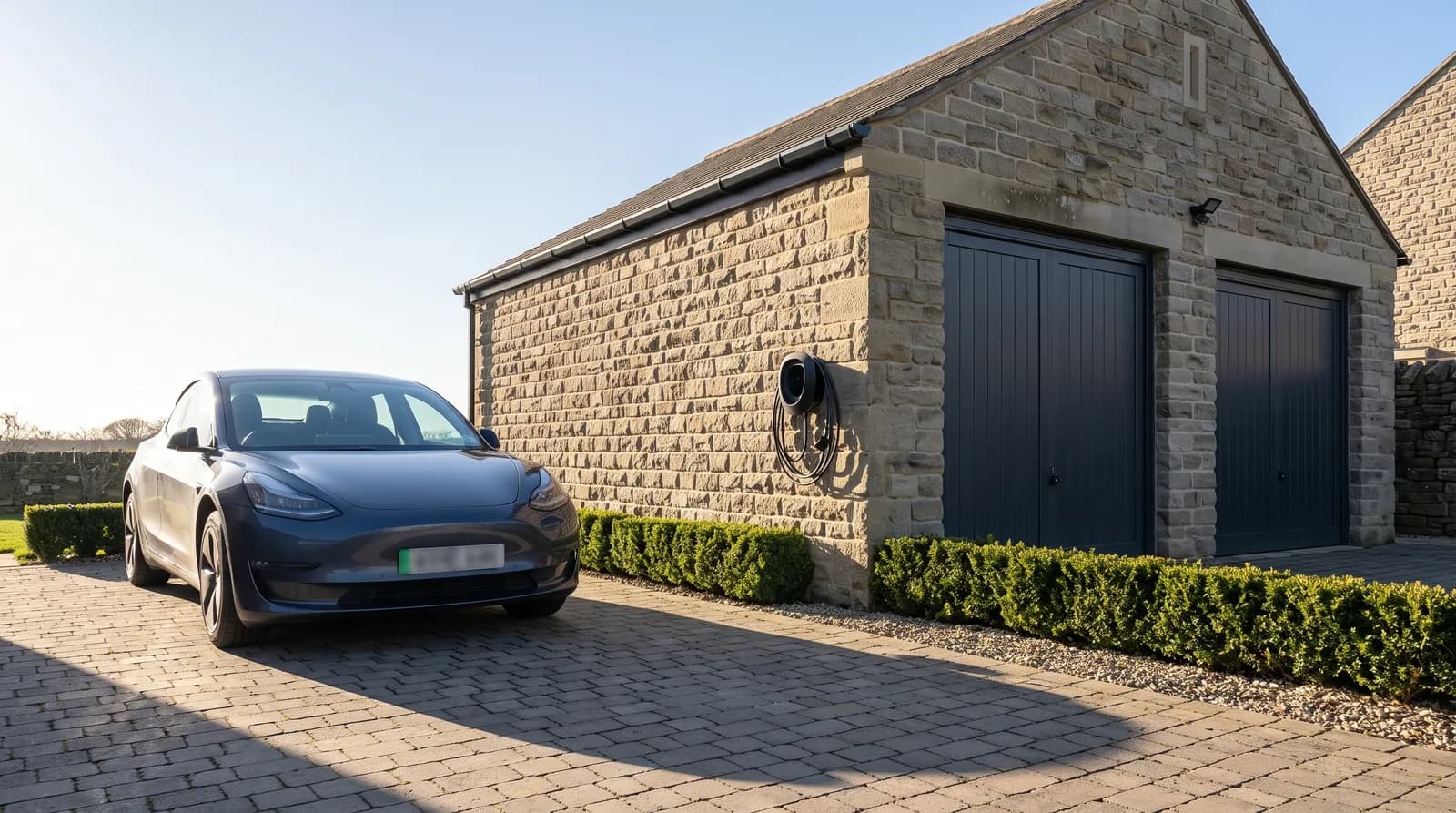
Home EV charger installation explained
A home charger is a new dedicated circuit from your consumer unit to a wall box near where you park. Everything else is detail about how the cable gets there.
Read, 6 minGetting ready for your installation
Most delays on installation day come from three things: blocked access to the consumer unit, no decision on where the unit goes, and permission that has not arrived.
Read, 4 minWhere to put an EV charger
As close to where the car parks as the wall allows, at a height where the lead does not drag, and never where the cable crosses somewhere people walk.
Read, 4 minTethered vs untethered
Tethered has the cable permanently attached. Untethered means you plug your own cable in. The installation, the speed and the certification are identical.
Read, 3 minWhat an EV charger costs
Two costs: the unit, and the work. The unit is a published price. The work depends almost entirely on how far the cable travels and what your consumer unit looks like.
Read, 5 minHome vs public charging costs
Yes, it is cheaper to charge at home, and on an overnight EV tariff it is cheaper again. Public rapid charging carries hardware, site and grid costs that your driveway does not.
Read, 6 minCharging from solar panels
A charger with solar diversion throttles the charge to match what your panels are exporting, so the car takes generation you would otherwise sell back cheaply.
Read, 4 minThree-phase and load management
Three-phase is what makes 11kW and 22kW charging possible. Load management is what lets several chargers share one supply without tripping it. Most sites need the second, not the first.
Read, 5 minCharging a van fleet
Fleet charging is a scheduling problem before it is an electrical one. What matters is how long each vehicle is stationary, not how fast a bay can charge.
Read, 5 minChoosing a charger
They all charge at 7kW. What separates them is solar diversion, tariff integration, whether the cable is attached, and whether they can share a supply with a second car.
Read, 4 minTools
EV charging calculators
The guides explain the method. The tools do the arithmetic on your figures instead of an average from someone else's house.
Charging cost calculator
What one charge costs, and what a year costs, comparing your day rate, an overnight EV tariff and a public rapid charger.
Open the calculatorCharger finder
Filter Zappi, Ohme, Hypervolt, Easee and the rest by solar, tariff, cable type and whether two cars share the supply.
Open the finderWhat the guides cover
Installation, cost and the cable route
Between them these ten guides answer the same three questions the survey does, in more detail than a quote has room for.
Next step
Read enough? Send the postcode and get a price.
Send the postcode and what the property is, and we will come back with the quote or the one question still outstanding.
Get a quote
Get an EV charger quote for your property
Seven quick questions. We reply with either a fixed price or the one thing we still need to know.
- No cost, and no obligation to book anything
- Your details are never sold on or passed around
- A fixed price for the work described, in writing
Would rather talk it through? Call 01246 952042.