Guide, 5 min read
Three-phase EV charging and load management
Three-phase is what makes 11kW and 22kW charging possible. Load management is what lets several chargers share one supply without tripping it. Most sites need the second, not the first.
Get a price
Where does it need to go? Two taps and a postcode gets you a price.
What three-phase is
Most British homes have a single-phase supply: one live conductor, and a practical ceiling around 7kW for a charger. Commercial premises frequently have three phases, which allows much higher loads.
A three-phase charger can deliver 11kW or 22kW. That only helps if the vehicle can accept it, and most cars cap their onboard AC charger at 7.4kW or 11kW. A 22kW unit charging a 7.4kW car charges at 7.4kW.
Why load management matters more
The question on a commercial site is rarely how fast one bay charges. It is how many bays can exist without paying for a bigger supply.
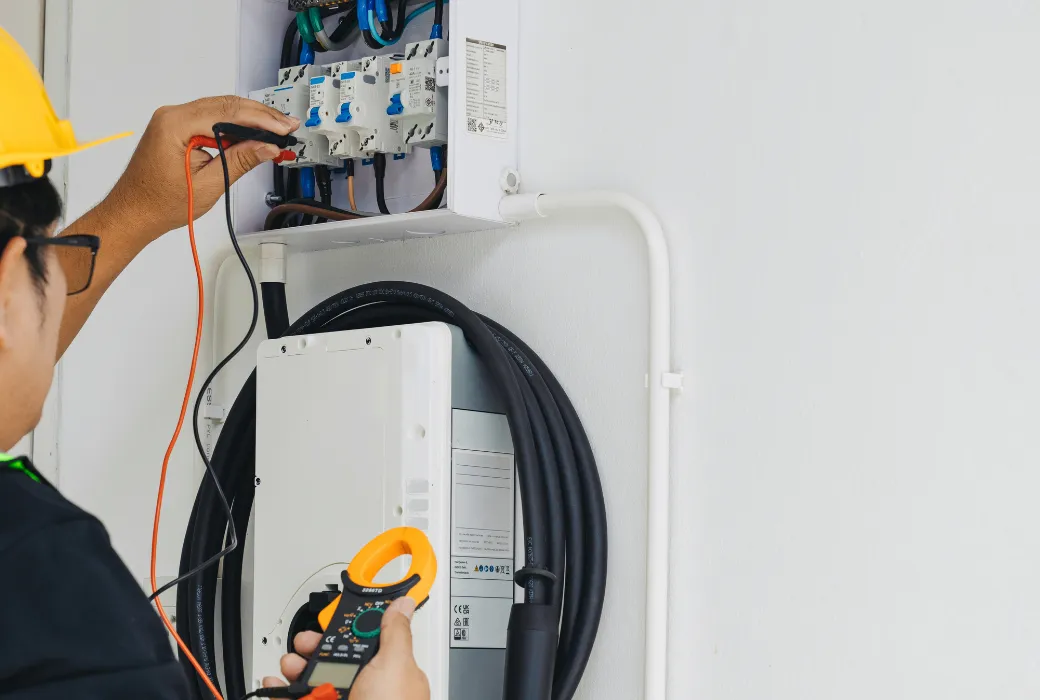
Load management measures what the site is drawing and shares whatever is spare across the charging bays, moment by moment. Instead of four bays each demanding their full rating simultaneously, they cooperate within the capacity you already have.
What that means in practice
- More bays on the same supply, without a network operator application
- Charging shifted into the hours when the site is quiet
- Vehicles prioritised by when they are next needed
- A supply upgrade avoided or deferred, which is frequently the largest single cost
At home
The domestic version is load curtailment: the charger reduces its draw when the house needs the capacity, so the main fuse never sees more than it should.
For two cars on one supply the same principle applies across both chargers. It has to be designed in from the start.
The technical bit
The numbers, in one place
Physical and regulatory constants. These do not vary between installers.
Unit availability and installed prices move. Both are confirmed in writing for your property before you are asked to accept anything.
Next step
Send us the postcode and we will tell you what your property needs.
Send the postcode and what the property is, and we will come back with the quote or the one question still outstanding.
Questions
EV charging questions on this
Can I get three-phase installed at home?
It is possible and it is rarely worth it. The network operator charges for the work, and unless your car and your usage genuinely need more than 7kW overnight it buys you very little.
How many bays can load management support?
It depends on the site's spare capacity and how long vehicles are parked. Long dwell times mean many bays work comfortably on a modest supply, because nothing needs to charge quickly.
Does load management slow charging down?
Sometimes, and usually at moments when it does not matter. A van parked from six in the evening until seven in the morning does not care whether it charged at 7kW or 3kW at two in the morning.
Get a quote
Get an EV charger quote for your property
Seven quick questions. We reply with either a fixed price or the one thing we still need to know.
- No cost, and no obligation to book anything
- Your details are never sold on or passed around
- A fixed price for the work described, in writing
Would rather talk it through? Call 01246 952042.