Guide, 6 min read
Home EV charger installation explained
A home charger is a new dedicated circuit from your consumer unit to a wall box near where you park. Everything else is detail about how the cable gets there.
Get a price
Where does it need to go? Two taps and a postcode gets you a price.
What the job actually is
Strip away the marketing and a home charger installation is one circuit. It starts at your consumer unit, gets its own protective device, runs to a point on an outside wall, and ends at a box the car plugs into. That circuit does nothing else.
It is a dedicated circuit because a car draws close to its maximum for hours at a time. Household circuits are designed around short bursts of demand from kettles and showers. Sustained load is a different problem, and it is why plugging a car into a socket for ten hours is a bad idea.
The survey comes first
Three things get checked before anyone quotes: the rating of your main fuse, the spare capacity in your consumer unit, and your earthing arrangement.
The main fuse is usually 60A, 80A or 100A. A 7kW charger draws around 32A. If your fuse is 60A and you have an electric shower and an electric hob, the arithmetic gets tight, and that is what load curtailment solves.
The earthing arrangement matters because an outdoor chargepoint needs specific protective measures, and what those are depends on how the property is earthed. Older rural properties on a TT arrangement need a different approach from a modern estate house.
The cable route is most of the price
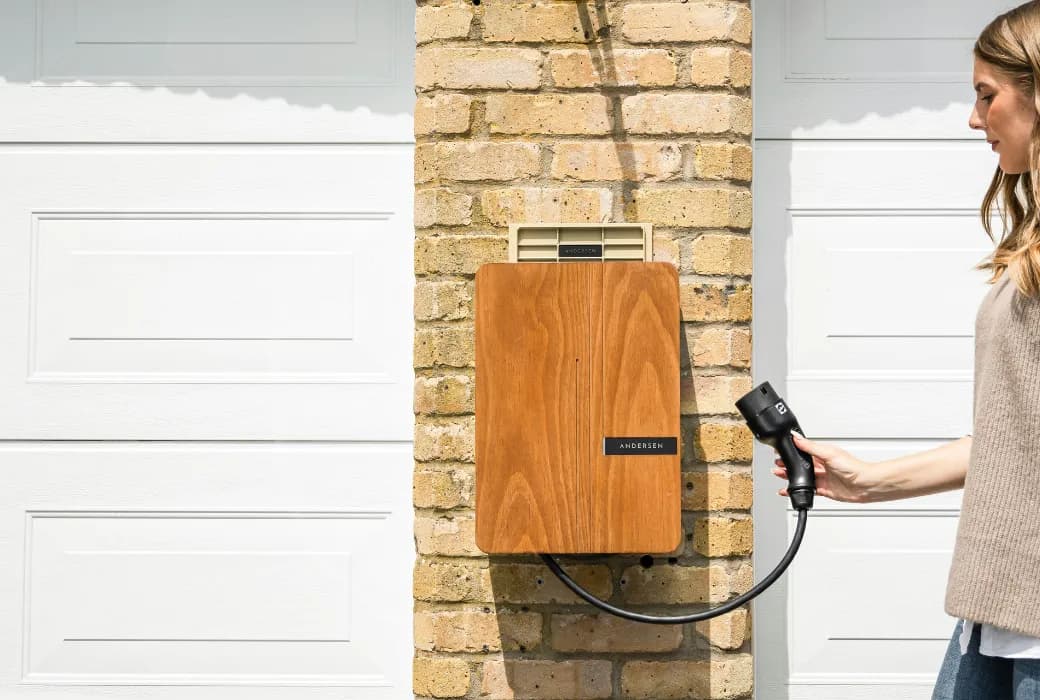
The hardware costs roughly what the hardware costs. What varies between one house and the next is how far the cable has to travel and what it has to get past on the way.
A garage on the same wall as the consumer unit is a couple of metres of cable. A detached garage at the bottom of a garden is a trench, a duct, armoured cable and reinstatement. Both are ordinary jobs, and they are not ordinary prices.
- Clipped along a wall: cheapest, quickest, visible
- Trunked: tidier, slightly more work
- Buried in a duct: most expensive, best finish, needed for detached garages and across driveways
- Through a loft or under a floor: depends entirely on access
What happens on the day
Two to four hours for a straightforward job. Longer runs, buried ducts or a consumer unit change make it a full day.
The circuit is installed and tested, the unit is mounted and commissioned, the app is set up, and the results are recorded. You should end up with an electrical installation certificate for the new circuit and the test results that go with it.
Notification and paperwork
The work is notifiable under Part P of the Building Regulations, which means a competent person has to carry it out and certify it. Your network operator also needs to know about the new load. For a standard 7kW single-phase installation that is normally a notification after the event. Larger loads need an application before the work starts.
If you are claiming a government grant, the installer must be OZEV-authorised and the sequence matters. Check the grants page before you book anything.
The technical bit
The numbers, in one place
Physical and regulatory constants. These do not vary between installers.
Unit availability and installed prices move. Both are confirmed in writing for your property before you are asked to accept anything.
Next step
Send us the postcode and we will tell you what your property needs.
Send the postcode and what the property is, and we will come back with the quote or the one question still outstanding.
Questions
EV charging questions on this
Can any electrician install an EV charger?
They need to be competent in this specific work and registered with a competent person scheme to self-certify it. For grant-funded work they also need to be OZEV-authorised, which is a separate registration.
Do I need a new consumer unit?
Only if the existing one has no spare capacity or lacks the right protection. Plenty of boards take a charger circuit as they stand. It is checked at survey so it is priced in, not sprung on you.
How far can the charger be from the fuse board?
Further than most people think, though the cable has to be sized for the run and longer runs cost more. Thirty metres is routine. It is a cost question, not usually a feasibility one.
Get a quote
Get an EV charger quote for your property
Seven quick questions. We reply with either a fixed price or the one thing we still need to know.
- No cost, and no obligation to book anything
- Your details are never sold on or passed around
- A fixed price for the work described, in writing
Would rather talk it through? Call 01246 952042.